REVIEW · LISBON
Tuk Tuk Lisbon: Exploring Urban Art
Book on Viator →Run by TukGuide Portugal · Bookable on Viator
Lisbon’s walls tell stories fast. This urban art tour strings together big-name murals, sculpture-like paint, and artist-built texture across several neighborhoods without wasting time.
I love the private guide focus. You’re not just seeing murals; you’re getting the who-and-why behind each one. I also like the tuk tuk transport—it keeps things moving while you’re hunting for details on buildings and walls.
One caution: it’s not set up for everyone. It’s not recommended for pregnant women or people with reduced mobility, and children under 7 aren’t allowed, so it helps to plan based on your group’s needs.
In This Review
- Key Things You’ll Really Notice
- Lisbon Urban Art, But With Smart Route Planning
- Price and Value: What $93.73 Buys You in the Real World
- Pickup, Timing, and How to Prepare for a Murals-First Walk
- Santa Apolónia Sidewalk Stop: Pichi&Avo’s Color + Sculpture-Like Attitude
- Santa Clara Field: André Saraiva’s 170-Meter Tile Masterpiece
- Travessa das Merceeiras: Spotting Vhils (Alexandre Farto) in Plain Sight
- Graça and Literary Faces: Sophia, Natália, and Florbela in Street Art
- Avenida Fontes Pereira de Melo: The International Ensemble in Three Vacant Buildings
- Lx Factory Finale: Bordalo II’s Garbage Bee and a Change of Gear
- What Kind of Guide Makes This Tour Feel Worth It
- Who Should Book This Tuk Tuk Lisbon Art Tour
- My Practical Tips for Getting the Most Out of the Murals
- Should You Book Tuk Tuk Lisbon: Exploring Urban Art?
- FAQ
- How long is the Tuk Tuk Lisbon street art tour?
- Is pickup offered, and where can we meet?
- What’s included in the price?
- Is the tour offered in English?
- Are kids allowed?
- Can I cancel for a full refund?
Key Things You’ll Really Notice
- Pichi&Avo’s Santa Apolónia mural blends coarse graffiti energy with careful drawing, plus that giant sculptural figure
- André Saraiva’s Santa Clara tile wall runs 170 meters long and covers about 1,000 m² with roughly 53,000 tiles
- Vhils (Alexandre Farto) in Travessa das Merceeiras—a face hidden in plain sight, designed for close looking
- Literature-themed street art in Graça featuring Eime, Mariana Dias Coutinho, and faces tied to Portuguese authors
- Avenida Fontes Pereira de Melo’s international artists piece across three vacant buildings, highlighted by The Guardian
- Lx Factory as a finale, where Bordalo II turns trash into an oversized bee you can actually get near
Lisbon Urban Art, But With Smart Route Planning
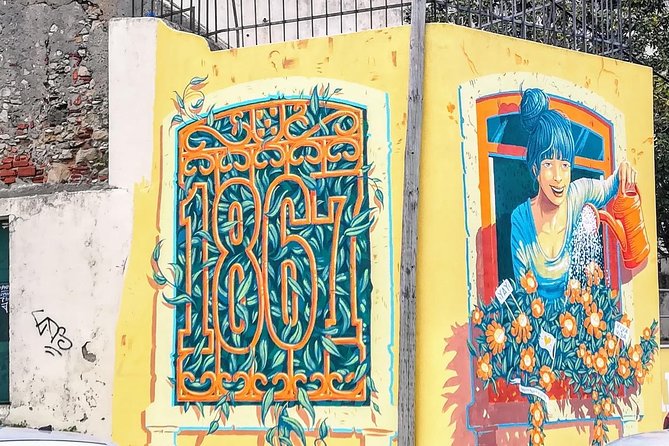
Urban art in Lisbon is everywhere, but it can be random. This experience fixes that. Instead of wandering with no plan (or making it a scavenger hunt that eats your day), you get a short, paced route that hits the “pay attention” walls.
The tuk tuk part matters more than you might think. Street art is visual, but you also need time to stop, step back, and take photos without holding up a whole crowd. With private transportation, you’re more likely to get those moments where the artwork clicks—the brushstrokes, the scale, the way letters sit next to painted faces.
Also, you’re going to be taught how to look. Names like Pichi&Avo, André Saraiva, Vhils, and Bordalo II sound cool (and they are), but the real value is learning the different languages of street art: graffiti tags versus tile precision versus carved-looking portrait work.
You can also read our reviews of more tours and experiences in Lisbon.

Price and Value: What $93.73 Buys You in the Real World
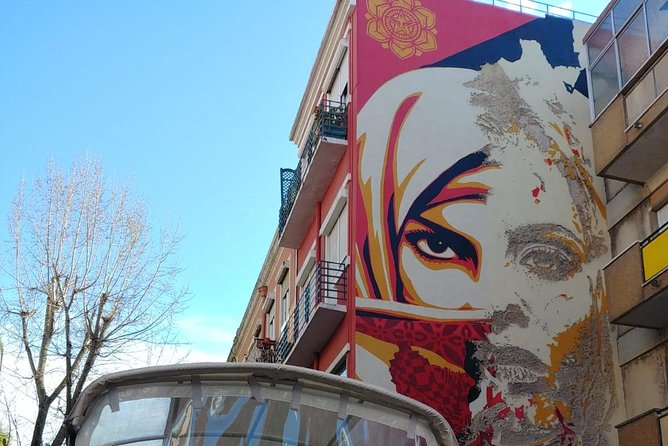
At $93.73 per person, the cost isn’t just for riding around. You’re paying for three practical things:
- Guided tour + private guide
- Private transportation (tuk tuk)
- A route that saves you time between neighborhoods and stops
That means less “how do we get there?” and more “what am I looking at right now?” You’re also getting mobile ticket convenience, plus group discounts if your setup works for it. And it’s private—only your group participates—so you can ask questions without feeling like you’re slowing down a big bus tour.
One more detail that affects value: the tour is offered in English, and it’s designed for most travelers to participate. It’s also limited to 6 seats and a maximum capacity of 400 kg, which keeps the experience from feeling chaotic.
If you’re planning to book soon, note the demand pattern: it’s usually booked about 45 days in advance on average. If your dates are flexible, you can shop around. If not, lock it in early.
Pickup, Timing, and How to Prepare for a Murals-First Walk
The tour can pick you up at many convenient points around Lisbon. They pull from Lisbon hotels and Airbnbs near the historic center, plus cruise terminals and spots near the historic area like restaurants. They also suggest two meeting points that usually work smoothly: Time Out Market and Alto do Parque Eduardo VII.
For a 2 to 3 hour street-art session, that matters. Lisbon is hilly and busy in spots, so starting near where you already are helps you spend your energy on the art.
Practical prep I recommend:
- Wear shoes you’re happy to stand in for photos.
- Bring your phone camera settings if you care about night shots (this is daylight-friendly, but you never know what time your stop lines up).
- If you’re sensitive to walking, keep your expectations flexible. Some of the best street art is placed where you can only access it on foot for the final meter or two.
Photos are part of the experience. In particular, one guide approach that shows up in the feedback is allowing you to time stops for pictures when traffic allows. That’s the difference between a drive-by and a “got it” moment.
Santa Apolónia Sidewalk Stop: Pichi&Avo’s Color + Sculpture-Like Attitude
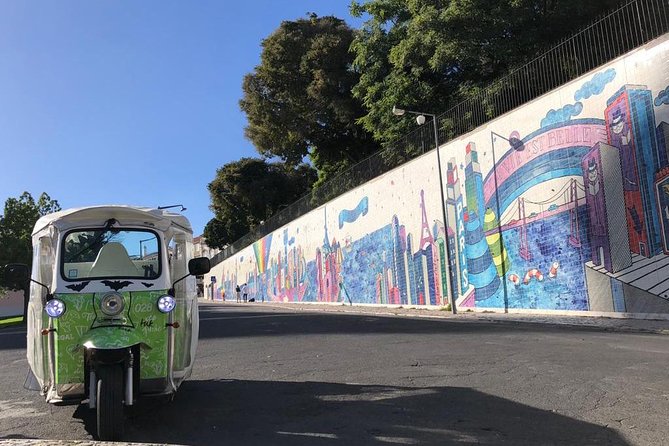
Your first listed stop is the sidewalk of Santa Apolónia, along the Calçada de Santa Apolónia. This is where you meet Pichi&Avo, the Spanish duo known for mixing classic art techniques with the rebellious texture of graffiti.
What you’re looking for here is not subtle. The mural includes a large sculptural figure layered over what’s described as infinite tags. That contrast is the point: you get coarse, energetic brushwork alongside more careful drawing. It’s like the wall is arguing with itself—street chaos meeting controlled line.
Why this stop works at the start:
- It sets the tone right away, so you understand how to read the rest of the route.
- You can train your eye for scale and layering before you move to tile work and portrait-style pieces later.
A small drawback to keep in mind: public streets and traffic can affect how long you can safely pause. The good news is that the experience is built around private transportation, so the guide has flexibility when conditions allow.
Santa Clara Field: André Saraiva’s 170-Meter Tile Masterpiece
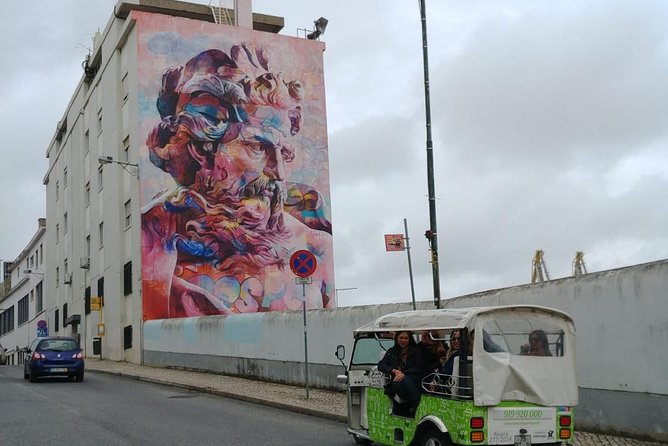
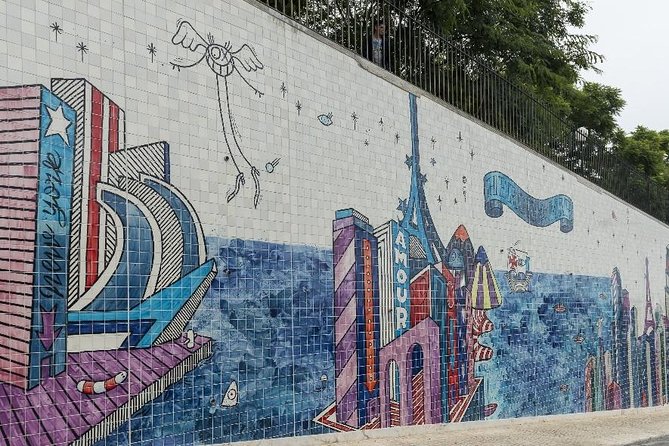
Next up is the Santa Clara Field, focused on a wall tied to Jardim Botto Machado (Campo de Santa Clara / Feira da Ladra). Here you see a long tile mural by André Saraiva that covers 170 meters of wall, in about 1,000 m², using roughly 53,000 tiles.
Tile murals have a different mood than spray paint. You can see structure. You can see repetition. You can also see patience. The effect is that the artwork doesn’t just sit on a building—it changes the whole surface identity of the street.
What’s useful for you as a viewer:
- Look for the way the composition holds together at different distances.
- Up close, check the tile edges and how the image is assembled.
- Step back to understand it as a wall-spanning scene, not a single panel.
Possible consideration: this is a “scale” stop. If you’re short on time in Lisbon in general, you might feel pulled to move on quickly. Don’t. The whole point is that this is big by design. Let your eyes adjust.




Travessa das Merceeiras: Spotting Vhils (Alexandre Farto) in Plain Sight
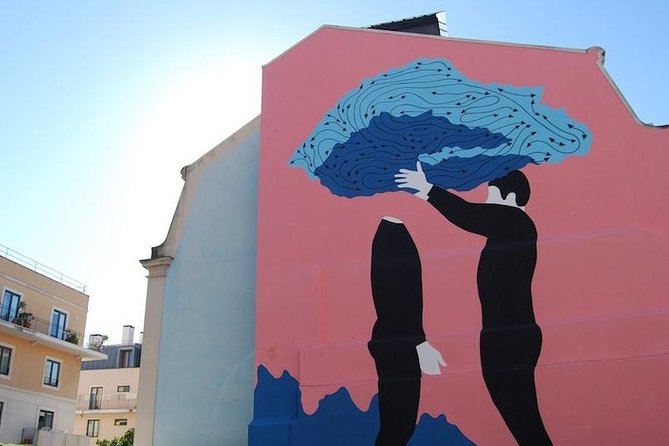
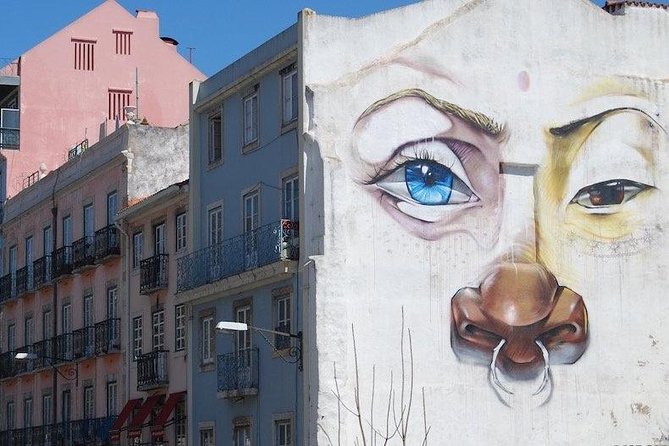
Then you get Vhils, whose real name is Alexandre Farto. One of his earlier faces in Lisbon is described as hidden in Travessa das Merceeiras.
This is the kind of street art that rewards attention. Rather than an image screaming from far away, carved or cut-into-style portrait work tends to feel like it’s emerging as you get closer. The “hidden in the city” feel is part of the experience.
Why I think this stop hits:
- It changes the pacing from broad wall scenes to human-scale viewing.
- It teaches you to scan, not just admire.
- It gives you a break from pure color density and letters.
If you like portraits, this is one of the best moments on the route. If you’re not usually a street-art person, you might still find yourself stopping because it feels like the artwork found you.
Graça and Literary Faces: Sophia, Natália, and Florbela in Street Art
As you continue, you’ll hit a set of pieces tied to the Graça district and Portuguese literature. In 2014, artists honored national literary figures connected to Graça.
Here’s what to look for:
- Sophia de Mello Breyner appears in Rua Josefa de Óbidos, made by Eime.
- Natália Correia and Florbela Espanca are portrayed in Travessa do Monte, created by Mariana Dias Coutinho.
What makes this section special is the connection. Street art sometimes feels random, but here it’s anchored to real names you can attach to the city. If you enjoy reading as well as sightseeing, this part makes the walls feel more personal.
You’re also near viewpoints of Graça and Senhora do Monte. Even if you don’t turn it into a full viewpoint detour, just knowing they’re close helps you plan photos—especially if the light changes while you’re out on the streets.
One practical consideration: these areas can be busy. Build in patience for a quick pause, then move on to the next face.
Avenida Fontes Pereira de Melo: The International Ensemble in Three Vacant Buildings
Another highlight is a stretch on Avenida Fontes Pereira de Melo, where international artists created a work across three vacant buildings. The artists named here are:
- Os Gémeos (Brazil)
- Blu and Eric Il Cane (Italy)
- Sam3 (Spain)
The description also notes that the piece was considered one of the 10 best in the world by the British newspaper The Guardian. That’s not a guarantee of your taste—but it does signal scale, ambition, and the kind of project that attracts global attention.
How to enjoy this stop:
- Treat it like a mural world, not a single picture.
- Walk your eyes across building lines, because these compositions often rely on the space between structures.
- If you’re with a small group, you’ll likely get more time to compare sections up close.
A possible drawback: when art is this spread out, you can miss details if you rush. Try not to “check it off.” This is where you want a slow gaze for at least a minute or two per building.
Lx Factory Finale: Bordalo II’s Garbage Bee and a Change of Gear
The final stop is Lx Factory, described as a creative factory where there are always plenty of works by well-known street artists. One name you’ll hear right away here is Bordalo II, with a huge bee made of garbage.
This finale is more than a last photo. It acts like a reset. Instead of only hunting for murals in the street corridor, you end in a place where creative culture sits in a more open setting. If you want to keep browsing art after the ride, Lx Factory is a natural place to do it.
Why the order helps:
- Earlier stops train you to decode different styles.
- The last stop gives you a more playful, symbolic piece to end on.
- You finish with something that feels slightly whimsical even though it’s still rooted in street-art commentary.
If you’re the type who likes to end tours with a place to wander on your own, Lx Factory is a solid match.
What Kind of Guide Makes This Tour Feel Worth It
This experience is built around a private guide, and that’s a big deal with street art. It’s not just facts. It’s the ability to explain what you’re seeing in a way that actually changes how you look at the next wall.
The feedback I’m using to inform my sense of the experience highlights guides like Nuno, Filipe, and Pifas. The common thread: they connect the art to the city and share more than mural trivia. You get a sense of place, not just images.
If you care about context, that’s where this tour pays off. If you only want quick pictures, you can still do that—but you’ll miss half the point.
Who Should Book This Tuk Tuk Lisbon Art Tour
This is a great fit if you want:
- A short 2 to 3 hour route with high hit-rate murals
- Private pacing with a guide who can answer questions
- Urban art that includes graffiti attitude, tile precision, portrait styles, and literature links
- Convenient pickup from hotels/Airbnbs near the historic center or from cruise terminals
It’s less ideal if:
- You’re expecting a fully accessible experience. The tour is not recommended for pregnant women or people with reduced mobility.
- You’re traveling with kids under 7, since children under 7 aren’t allowed.
Also, think about your comfort with cities and sidewalks. This is Lisbon street level. That means you’re outside for real and you’ll move between stops.
My Practical Tips for Getting the Most Out of the Murals
A few simple things that help on a route like this:
- Use your guide’s cues. If they point out what to notice on a wall, pay attention. Street art can look flat until someone explains the trick.
- Take one wide shot, then one close shot, then a medium shot. Many of these pieces (especially tile and portrait work) change how they read depending on distance.
- If you want photos at each stop, don’t cram. Let the guide time the pause and take your photos in a calm sequence.
- If you get an offer for a route moment near a viewpoint area like Graça, consider saving energy for that. Lisbon rewards timing with light.
One small piece of strategy: if you’re the kind of person who gets photo-fogged, pick 3 “must capture” murals and only then let yourself freestyle. You’ll feel less stressed.
Should You Book Tuk Tuk Lisbon: Exploring Urban Art?
If you want a focused, high-value street-art introduction to Lisbon, I think this is a strong booking. For $93.73 per person, you’re getting more than transport. You’re buying time, guidance, and a route that hits major styles: Pichi&Avo, André Saraiva tiles, Vhils portrait work, literature-inspired faces in Graça, an international artist wall on Avenida Fontes Pereira de Melo, and a creative-factory finish at Lx Factory with Bordalo II.
Book it if your priority is street art with context and you like moving between neighborhoods without planning every turn yourself.
Skip it (or consider another format) if your group needs strong accessibility support or you’re traveling with kids under 7.
If your schedule is tight, and you still want Lisbon to feel like more than viewpoints and azulejos, this route does exactly that—by letting the city’s walls speak.
FAQ
How long is the Tuk Tuk Lisbon street art tour?
The tour lasts about 2 to 3 hours.
Is pickup offered, and where can we meet?
Pickup is offered at Lisbon hotels and Airbnbs near the historic centre, in the cruise terminals, and at nearby restaurants. They also suggest Time Out Market and Alto do Parque Eduardo VII as practical meeting points.
What’s included in the price?
The price includes a guided tour, a private guide, and private transportation. Food, drinks, and monument tickets are not included.
Is the tour offered in English?
Yes, it’s offered in English.
Are kids allowed?
Children under 7 are not allowed.
Can I cancel for a full refund?
Yes. You can cancel up to 24 hours in advance for a full refund. If you cancel less than 24 hours before the start time, you won’t get a refund.